

News
World Refugee Day: Group Breaks Menstrual Hygiene Stigma, Empowers Women and Girls at Abuja IDP Camp


By Praise Chinecherem
For women and girls living in displacement, access to basic menstrual hygiene can become a daily struggle—one compounded by poverty, inadequate facilities, stigma and limited access to reliable health information.
But at the Kuchigoro Internally Displaced Persons (IDP) Camp in Abuja, a World Refugee Day outreach sought to change that narrative by putting menstrual health, dignity and education at the centre of its intervention.
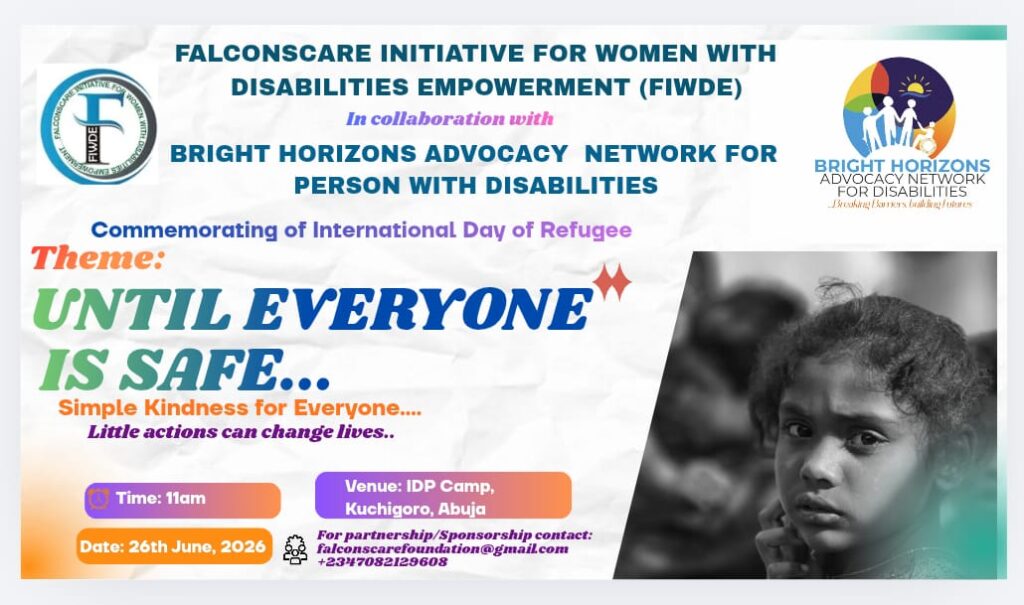
The programme, organised by the FalconsCare Initiative for Women with Disabilities Empowerment (FIWDE) in partnership with the Bright Horizons Advocacy Network for Persons with Disabilities, brought together 47 camp residents for sessions focused on menstrual hygiene, personal health, education and inclusion.
The initiative also provided food items and essential hygiene materials to participating families.
Speaking during the outreach, FIWDE Founder and Chief Executive Director, Uzoamaka Stella Ike, said the intervention was aimed at ensuring that displacement does not strip women and girls of their dignity or access to basic health information.
According to Ike, women and girls need accurate knowledge about menstruation to make informed decisions about their health and wellbeing.
She urged participants to reject the stigma and misinformation often associated with menstruation and encouraged them to seek appropriate medical attention whenever they experience health concerns.
“Menstruation is a natural part of life and should not be surrounded by shame or misinformation,” Ike said in outlining the focus of the sensitisation.
For girls growing up in displacement, however, the challenge extends beyond menstrual health.
The organisers also drew attention to the impact of poverty and displacement on children’s education, particularly the education of girls, who can face additional barriers to remaining in school.
Executive Director of the Bright Horizons Advocacy Network for Persons with Disabilities, Blessing Igwe James, encouraged parents at the camp to continue prioritising their children’s education despite difficult circumstances.
James, who shared her personal journey as a Deaf woman and disability rights advocate, said hardship should not be allowed to determine the future of vulnerable children.
She described education as a pathway to independence and better opportunities, urging parents to support their children’s aspirations even in the face of displacement and economic hardship.
The programme also provided an opportunity for residents to speak directly about the realities confronting them.
During an interactive dialogue, camp residents discussed some of their most pressing needs with the organisers, creating space for conversations that went beyond the immediate distribution of relief materials.
The organisers said such engagement was important because effective humanitarian interventions must be informed by the experiences and priorities of the communities they are intended to serve.
The outreach combined education with practical assistance, as food items and hygiene materials were distributed to participating families.
The camp’s women leader also commended FIWDE and the Bright Horizons Advocacy Network for the intervention, describing the support as a demonstration of solidarity with residents living under difficult conditions.
World Refugee Day, observed annually on June 20, provides an opportunity to draw attention to the experiences, rights and aspirations of refugees and displaced people around the world.
For internally displaced women and girls, those concerns often include issues that receive less attention in emergency-response conversations—access to menstrual products, safe sanitation, reproductive-health information, education and the ability to maintain personal dignity.
The Kuchigoro outreach therefore highlighted a broader point: humanitarian support cannot be limited to food and shelter alone.
For a girl navigating adolescence in displacement, having access to menstrual products and accurate health information can affect her confidence, school attendance and overall wellbeing.
For parents, keeping a child in school can represent an investment in a future that displacement has made uncertain.
And for communities living on the margins, being listened to can be as important as receiving material assistance.
The organisers said the World Refugee Day initiative reflects their continued commitment to promoting health, dignity and inclusion among internally displaced persons and other underserved communities.
As displacement continues to expose vulnerable populations to layers of social and economic hardship, initiatives such as the Kuchigoro outreach underscore the importance of interventions that address not only immediate survival needs but also the dignity, education and long-term wellbeing of those affected.
For the women and girls who participated, the message was clear: displacement may change where they live, but it should not determine their worth, health or future.
#