

Features
Disquiet over vandalization of Niger Bridge, other Critical Infrastructure Metals in Nigeria

By Olisemeka Sony
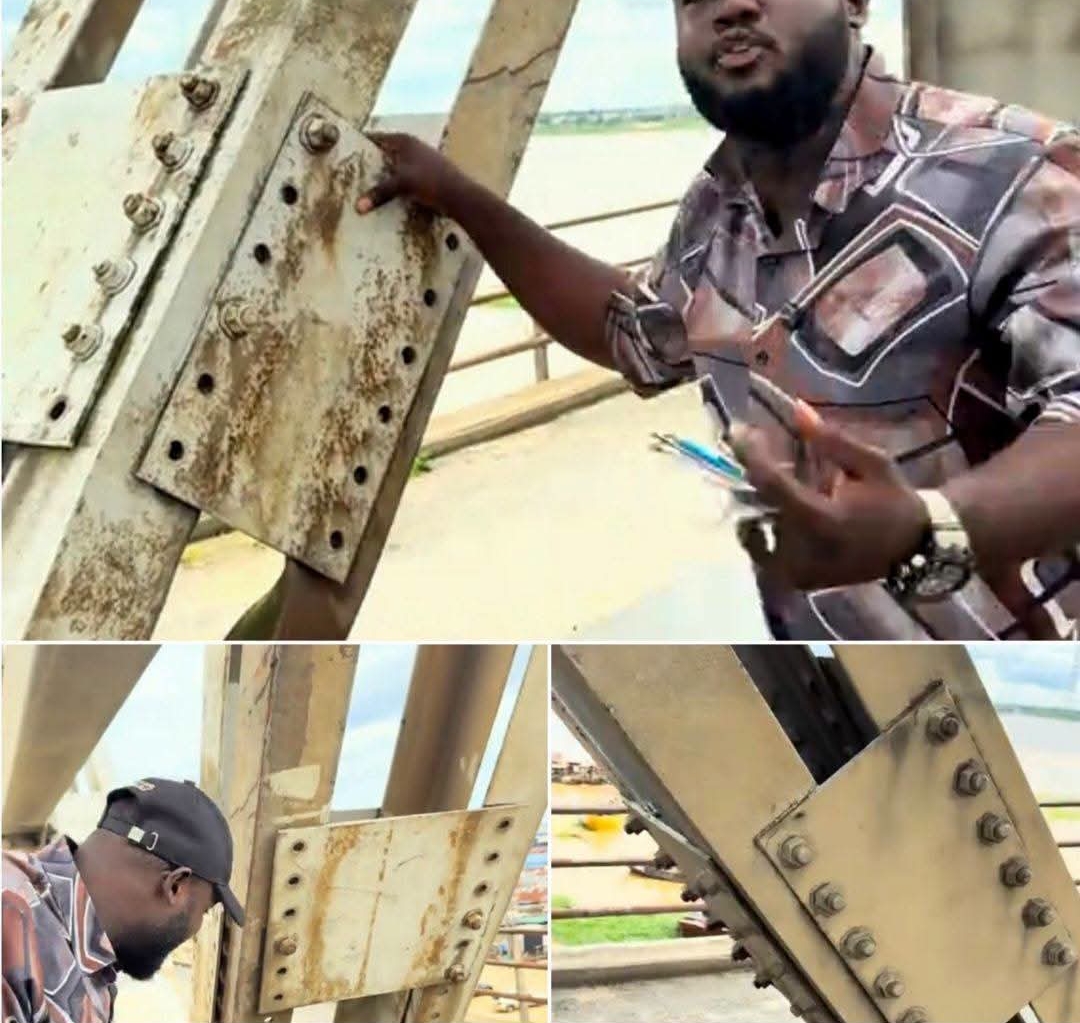
“This man and several others have been speaking up about what is going on at the iconic River Niger bridge. It appears some unscrupulous elements are loosening and stealing the bolts and nuts from the bridge.
“You can see the complete set and then see the ones that have been removed. Across the country, manhole covers are stolen barely a few days after being placed on the roads. Now this is a bridge that provides a critical connection to the southeast.
“If you say people should use the second Niger Bridge, I am sad to also tell you that those elements have started cutting off the metal on that bridge as well.
“I hope we never get to a point where the iron bars on this bridge will all be stolen.”
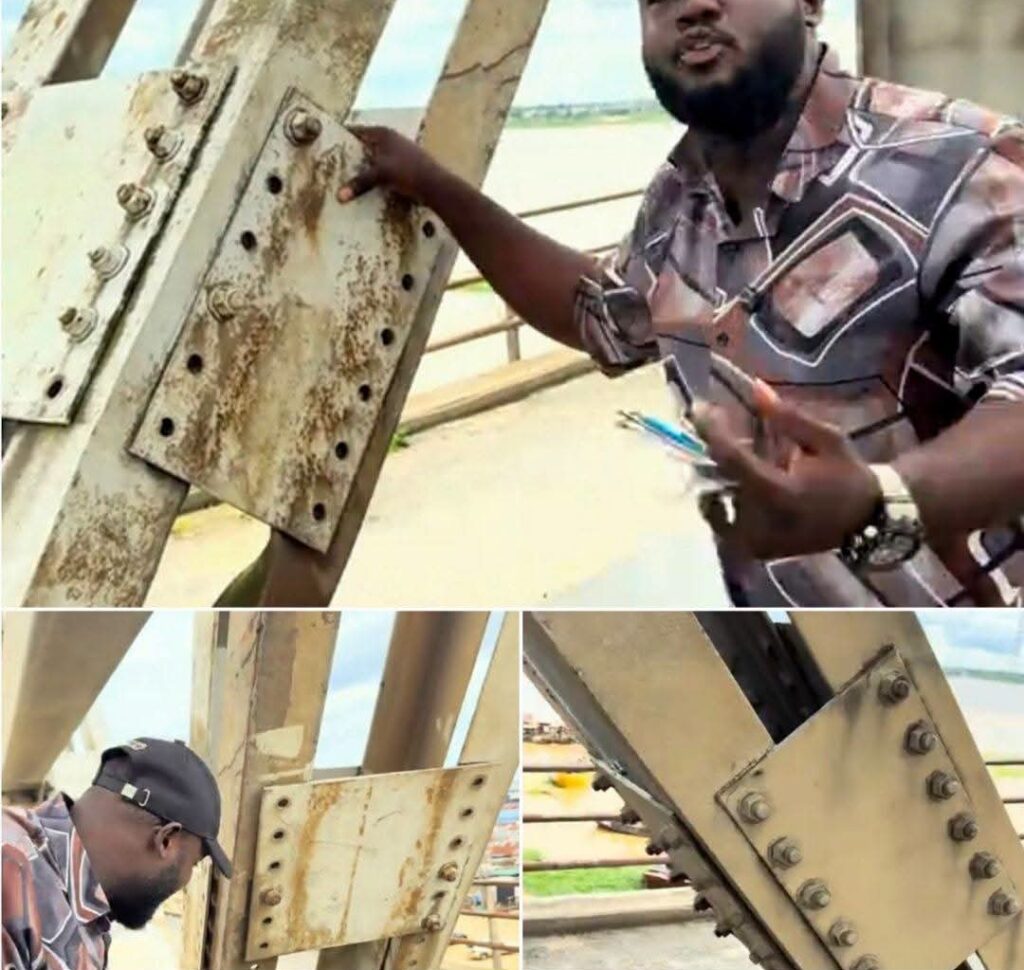
That alarm by citizen activist Martin Beck Nworah, circulating with images purporting to show missing bridge fittings, should not be dismissed as another social-media complaint. The specific claims about the current condition of the historic River Niger Bridge require an official structural assessment. But the larger warning is already beyond dispute: Nigeria is witnessing an expanding economy of metal theft in which public infrastructure is being dismantled piece by piece and sold for scrap.
The frightening part is not merely that somebody steals a manhole cover or a few bolts. It is that a growing number of Nigerians appear to have lost the ability—or willingness—to distinguish between scrap metal and the metallic components of functioning public infrastructure.
The expression “iron condemn”, once associated largely with people collecting discarded metal and household refuse for resale, has acquired a darker meaning. Across Nigerian cities, legitimate scrap collection exists alongside an increasingly visible criminal ecosystem in which metal is harvested from bridges, railway tracks, electricity infrastructure, streetlights, drainage systems, construction sites and public buildings.
Recent events make the scale of the problem difficult to ignore.
In August 2026, the Federal Government disclosed that approximately 1,800 manhole covers had been stolen from the Lagos section of the Lagos-Calabar Coastal Road since January. About one kilometre of clear-view fencing and 75 directional signs had also reportedly been removed. Investigators said suspected vandals were breaking manhole covers to extract reinforcement materials before selling them as scrap.
That is not petty theft. It is an organised assault on public investment. And it is happening at the same time that bridges are being attacked.
In August, Lagos State authorities announced the arrest of 27 suspected vandals following the discovery that iron rods, steel reinforcements, cables and other materials had been removed from the newly constructed Festac-Alakija Bridge. The state described the discovery as a “disturbing act of vandalism” and said the stolen components were essential to the integrity of the infrastructure.
This should change the way Nigerians understand the “iron condemn” phenomenon. The metal is not the crime. The crime is the deliberate conversion of infrastructure into scrap.
A railway track is not scrap because somebody can sell its steel. A bridge bolt is not scrap because it can fetch money from a dealer. A manhole cover does not become disposable simply because it is made of cast iron. The economic value of a component cannot be separated from the function it performs. This distinction is fundamental.
The Nigerian Railway Corporation has repeatedly confronted the same problem. In March 2025, NRC Managing Director Kayode Opeifa identified vandalism and the theft of rail tracks as the corporation’s biggest challenge, appealing to foundries and iron-melting companies not to buy railway tracks from vandals. He warned that anyone caught with stolen tracks would be treated and prosecuted as a criminal.
In another statement, Opeifa put the issue even more starkly: “We don’t have scraps in the Nigerian railway; we have national assets.”
That sentence deserves to become part of Nigeria’s national conversation. Because the crisis is ultimately about how a society values what it owns collectively.
The Second Niger Bridge provides perhaps the most disturbing illustration. Barely two months after its inauguration in May 2023, thieves removed a metal plate and an expansion-joint component from its Onitsha section. The resident engineer, Oluwaseyi Martins, warned that the incident represented a new trend and called for stronger surveillance.
The matter did not end there. In June 2024, Works Minister David Umahi again expressed alarm over vandalism of the bridge, including damage to expansion joints designed to accommodate thermal movement. He described the destruction as cruel and lamented that it was happening despite the deployment of private security.
In 2026, the problem has extended to the theft of iron rods from materials associated with the continuing Second Niger Bridge project. The Nigerian Army’s 63 Brigade reportedly arrested six suspects in May and recovered a truck, a bus and several iron rods allegedly stolen from the project site.
So the warning about the Niger Bridge is not occurring in isolation. It sits inside a national pattern. The question Nigerians should therefore be asking is not simply: “Who stole the metal?”
It is: “What kind of criminal economy has developed around the buying and selling of stolen infrastructure, and why has Nigeria allowed it to flourish?”
There cannot be a successful market for stolen public metal without buyers. The person who enters a bridge at night and removes a component is only the visible end of the chain. Behind him may be a transporter, a middleman, a scrap dealer, a metal processor and ultimately an industrial buyer. The poverty-stricken scavenger may receive a fraction of the final value. The larger commercial ecosystem is what makes the theft economically attractive. This is why simply arresting scavengers will not solve the problem. Nigeria needs to pursue the entire value chain.
The Federal Executive Council recognised the seriousness of the issue in May 2025 when it directed the Attorney-General of the Federation to strengthen legislation to criminalise the unlawful appropriation of government assets, specifically identifying scrap-metal vendors, miners and cart pushers among those involved in the theft of critical government property.
The National Assembly Joint Committees on Steel Development went even further in 2025, calling for a “state of emergency” on scrap collection and proposing the establishment of scrap collation centres across the six geopolitical zones.
Yet the persistence of the problem raises a troubling question: how many warnings, committees, arrests, directives and public statements does Nigeria need before the system changes?
States are now beginning to respond independently. Akwa Ibom considered legislation to regulate scrap dealers and require licensing. Niger State passed a bill regulating scavengers and scrap-metal dealers, citing security threats and the vandalism of public and private infrastructure. Ebonyi approved an executive bill to regulate the scrap-metal trade. Anambra announced a Special Task Force on Vandalisation in August 2026. Edo has arrested suspected “iron condemn” operators and moved to regulate the trade.
These measures are welcome. But fragmented state-by-state enforcement is insufficient for a national criminal market.
The metal stolen in one state can be transported and sold in another. A manhole cover removed in Abuja can disappear into a scrap market far from the scene of the crime. Railway components can be dismantled in one location and transported to a foundry elsewhere. The response must therefore be national, intelligence-led and coordinated.
The Nigeria Security and Civil Defence Corps already has statutory responsibilities relating to the protection of critical infrastructure, including surveillance and action against suspected vandalisers and illegal dealers in materials associated with public utilities and infrastructure.
The Nigerian Electricity Regulatory Commission and the Office of the National Security Adviser have also recognised that infrastructure protection requires cooperation between regulators, operators, security agencies and communities. In 2026, NERC announced work towards a shared database of assets, vandalism incidents and infraction reports, as well as a reporting platform intended to facilitate faster arrests and prosecution. That approach should be expanded beyond electricity.
Nigeria needs a national register of critical infrastructure components vulnerable to theft. Bridge fittings, railway tracks, transmission cables, transformer components, manhole covers, streetlight cables and other high-risk metallic assets should be catalogued, tracked and periodically inspected.
Every major bridge should have a documented baseline condition assessment. If 20 bolts are present today and five disappear next month, somebody should know before the public discovers the problem through a social-media video. That is the difference between surveillance and reaction.
The current culture is too often reactive. A component disappears. Citizens raise an alarm. Government officials inspect the site. Security is ordered. The missing component is replaced. Everyone moves on until another component disappears. This is an expensive cycle of institutional negligence.
Nigeria pays three times for vandalism: first to construct the infrastructure; second to repair or replace what criminals steal; and third through the economic and human consequences when the damaged infrastructure fails to perform its function.
Consider a missing manhole cover. Its scrap value may be insignificant compared with the cost of the road. But the open drain can kill a pedestrian, damage a vehicle or cause a serious accident. The economic calculation therefore becomes grotesque: a criminal makes a small profit while society assumes a potentially enormous liability.
The same logic applies to bridges. A missing bolt may appear insignificant to a layperson. But infrastructure is engineered as a system. Components have specified functions, tolerances and safety factors. The fact that one missing component does not immediately cause a collapse does not mean its removal is harmless.
This is why the repeated government reassurance that some vandalised structures remain “structurally sound” should never become an excuse for complacency. It is a statement about the condition of the structure at a particular moment, not a guarantee that continued theft is safe.
The greatest danger is gradual degradation. A society does not necessarily lose a bridge in one dramatic act. It can lose it through hundreds of seemingly insignificant acts: one bolt today, one cable tomorrow, one expansion-joint plate next week, one reinforcement bar after that.
Eventually, the accumulated damage becomes greater than the sum of its parts. There is also a deeper social question. Why are public assets so vulnerable?
Poverty is part of the explanation, but poverty alone cannot explain the organised purchase of stolen infrastructure. A desperately poor person may steal a piece of metal because he needs money. But someone with the resources to purchase tonnes of suspicious metal from unknown sources is participating in a different level of the economy.
Nor should legitimate scrap dealers be collectively criminalised. Representatives of the scrap industry themselves have complained that the criminal actions of a minority have unfairly branded the entire sector as thieves.
The answer is regulation, not indiscriminate persecution. A legitimate scrap business should be licensed, identifiable and auditable. Dealers should be required to document the source of high-risk metals. Certain materials—rail tracks, manhole covers, bridge components, transmission equipment and other clearly identifiable public infrastructure—should trigger mandatory proof-of-ownership requirements.
A dealer who cannot explain where a truckload of railway steel came from should not be allowed to claim ignorance. The same principle must apply to industrial buyers. If a foundry, metal processor or recycling company knowingly purchases stolen public infrastructure, it is not merely buying scrap. It is financing the theft.
This is where enforcement has often been weakest. Nigeria must stop concentrating exclusively on the man carrying the metal and start following the money.
There should be targeted investigations into scrap markets known to receive public infrastructure. Financial intelligence should be used where appropriate. Transport routes should be monitored. Repeat offenders should face meaningful prosecution. Assets acquired through organised infrastructure theft should be subject to lawful recovery procedures.
And convictions matter. A society cannot deter a profitable crime if the probability of punishment remains negligible.
There is also a role for ordinary citizens. Public infrastructure belongs to the public. The manhole outside a house, the bridge near a village, the railway line crossing a community and the electricity transformer serving a neighbourhood are not “government property” in the distant sense. They are community assets.
Citizens must therefore stop treating vandalism as somebody else’s problem. A person who sees people removing bridge fittings at night and says nothing is not necessarily a criminal, but he has missed an opportunity to prevent one. Communities should establish trusted channels for reporting suspicious activity without exposing whistle-blowers to retaliation. Traditional rulers, transport unions, market associations, neighbourhood groups, religious organisations and youth organisations can become part of the surveillance architecture.
Government, however, must make reporting worthwhile. Citizens will not repeatedly report crimes if reports disappear into bureaucratic files and offenders return to the same locations.
The alarm over the River Niger Bridge should therefore become a national wake-up call.
The historic bridge is more than steel, concrete, bolts and asphalt. It is a physical link between communities and economies. The Second Niger Bridge is more than a road project. It represents decades of political demands, engineering effort and public expenditure. Railway tracks are more than lengths of steel. Manhole covers are more than pieces of iron.
They are components of a functioning society. When Nigerians steal them for scrap, they are not simply stealing metal. They are dismantling the machinery through which society moves, trades, communicates, travels and remains safe.
And government cannot continue to respond only after citizens discover the damage. The time has come for a coordinated national war against infrastructure vandalism—one that combines regulation of the scrap-metal industry, intelligence gathering, technological surveillance, community participation, prosecution of vandals and, critically, prosecution of the buyers who create the market.
The government should establish clear national standards for scrap-metal licensing and traceability; security agencies should maintain dedicated infrastructure-protection operations; infrastructure owners should conduct routine structural audits; states should regulate scrap markets; and courts should ensure that cases do not disappear into procedural limbo.
Industrial operators and scrap dealers must demand proof of origin before purchasing suspicious metals. And citizens must understand that silence is not neutrality when public safety is at stake.
Nigeria has spent decades complaining about an infrastructure deficit. It is irrational to spend billions building bridges, railways, roads, power facilities and drainage systems only to allow criminals to dismantle them for the price of scrap.
The choice is becoming stark. Nigeria can continue replacing stolen infrastructure indefinitely, treating every theft as an isolated incident. Or it can recognise “iron condemn” vandalism for what it has increasingly become: a national economic, public-safety and security problem requiring a national response.
The warning from the Niger Bridge should not have to become a prophecy. We should not wait until the day citizens look at a bridge and discover that the bolts, plates, cables and reinforcing metals have disappeared before asking who was responsible.
The bridge is warning us now. Nigeria must listen now.
#