News
Anambra Govt Reaffirms Ban on Graduation Ceremonies, Christmas Parties, School Levies, Writing Textbooks

By Our Reporter
The Anambra State Government has reaffirmed its policy prohibiting public primary and junior secondary schools from organising graduation ceremonies, Christmas parties, and collecting graduation-related levies, while also reiterating its ban on the use of textbooks designed for pupils to write in.
The directive was contained in a circular dated July 10, 2026, issued by the Anambra State Universal Basic Education Board (ASUBEB) and signed by its Executive Chairman, Dr. Justina Anyadiegwu. The circular was addressed to Officers-in-Charge of Local Government Education Areas (LGEAs) and Education Secretaries across the state’s 21 local government areas.
According to the board, the reminder is aimed at ensuring strict compliance with the Anambra State Government’s education policy, which seeks to reduce the financial burden placed on parents and guardians by unnecessary school-related expenses.
The circular states:
“No primary or junior secondary school shall organise or permit any graduation ceremony, graduation levy, Christmas party, or any related activity inconsistent with the government’s directive.”

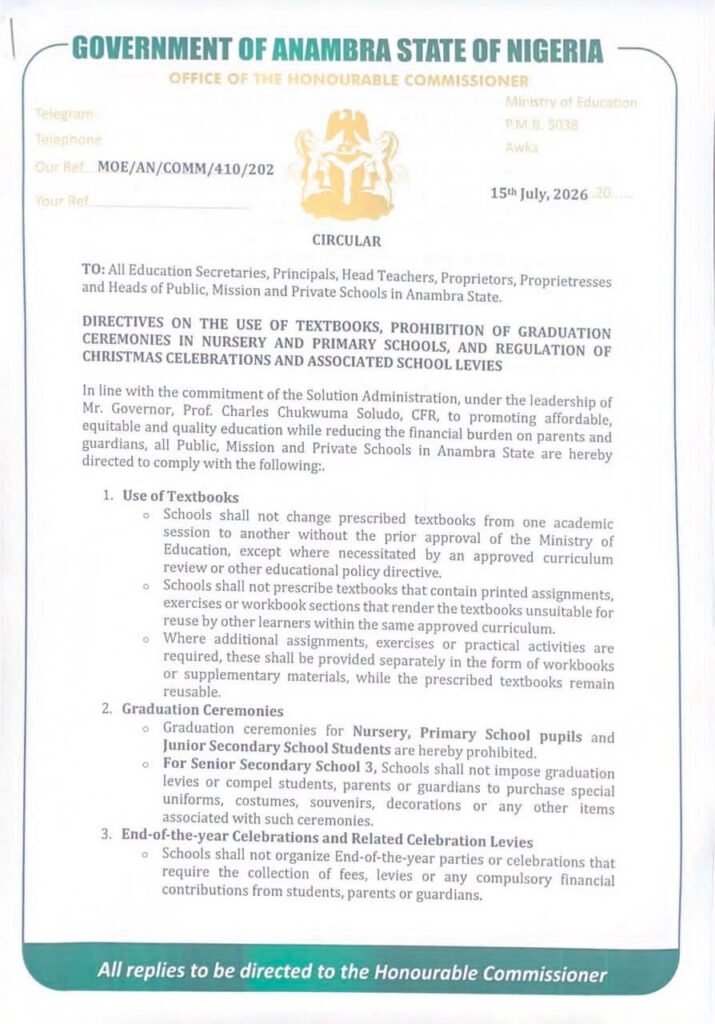

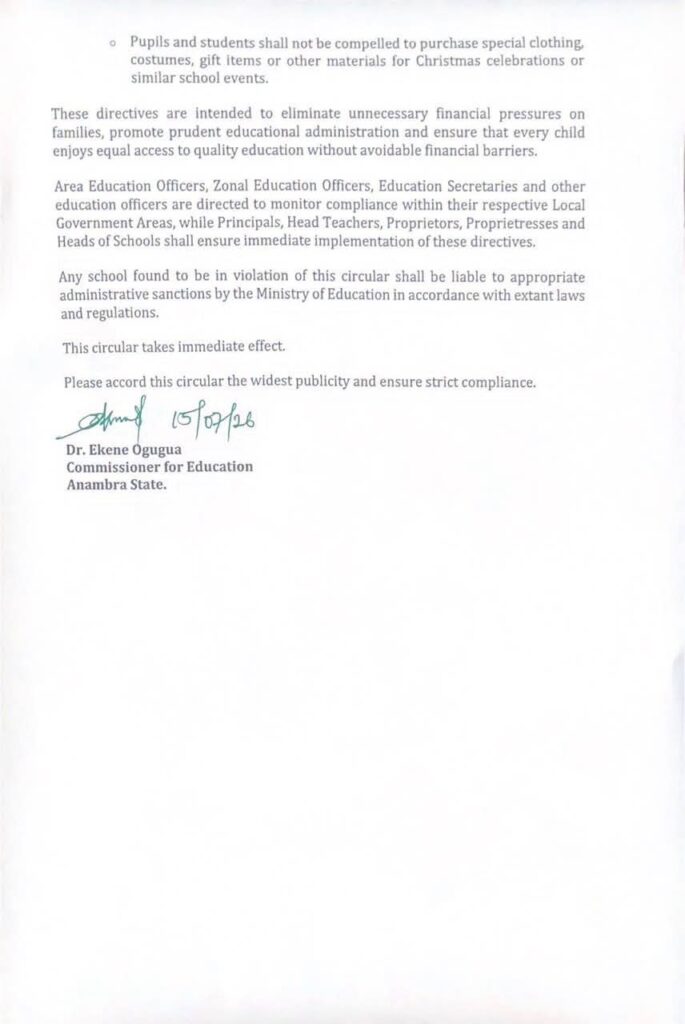
ASUBEB further directed all headteachers and school administrators to ensure full compliance with the policy, while Education Secretaries and LGEA officials were instructed to disseminate the directive to schools under their supervision and closely monitor implementation.
The board warned that any school found violating the directive would face appropriate administrative sanctions.
Ban on Writing Textbooks
Beyond ceremonies and levies, the state government also reiterated its position against the use of workbooks or textbooks that require pupils to write directly on their pages.
Governor Chukwuma Soludo, while announcing the policy in 2025, explained that the practice compels parents to purchase new books every academic session, making education unnecessarily expensive for families.
According to the governor:
“One of the measures includes discontinuing the use of textbooks designed for students to write in. This practice forces parents to buy new textbooks annually. Once a child finishes a class, he should be able to pass on his textbooks to his younger siblings.”
Soludo added that the reforms apply to government, private and mission schools as part of broader efforts to make education more affordable and accessible for all children in the state.
Government’s Objective
The renewed enforcement comes amid growing concerns over increasing school levies and elaborate graduation ceremonies, particularly for pupils in non-terminal classes.
State officials maintain that the policy is intended to eliminate avoidable financial pressures on parents, promote equity in education, and discourage commercialization of basic education.
Schools have therefore been reminded to comply fully with the government’s directives as authorities intensify monitoring across the state.