News
NSE tour first Niger bridge Onitsha, laud Tinubu over rehabilitation work

By Michael Ovat -Awka
The Nigerian Society of Engineers (NSE), Onitsha branch, has credited President Bola Ahmed Tinubu with the emergency repair of the first niger bridge Onitsha, Anambra State, saying the intervention marks one of the major infrastructure milestone of his administration.
They said the project, alongside other ongoing federal road works across the Southeast, reflected the administration’s commitment to addressing infrastructure gaps and promoting balanced national development.
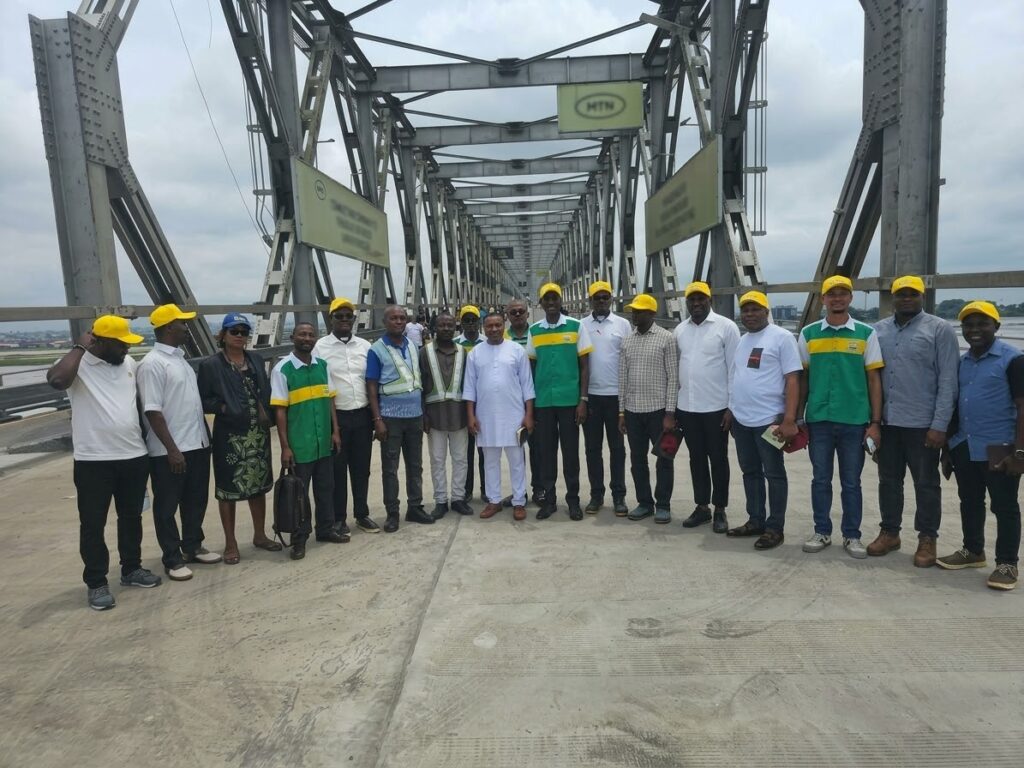
The commendation was contained in a communique jointly signed by the branch chairman, Engr Okey Nwosu and the technical secretary, Rev’d Engr Wisdom Onyemelukwe, and issued to Journalists at the end of it technical inspection tour at the first niger bridge, on Monday, October 5th, 2026.
The NSE Onitsha Branch expresses profound gratitude to Engr. Emenike and his team for his sound technical knowledge, intelligence, and humility.
The Branch also sincerely appreciates the Honourable Minister of Works, Engr. Dave Umahi, FNSE, for the timely intervention on the First Niger Bridge constructed in 1964 and commissioned in 1965.
This is a highly welcome development given the strategic economic importance of the bridge.
The branch commends the quality and standard of the repair works.
While the NSE Onitsha Branch appreciates the ongoing intervention and commends the quality of the rehabilitation works observed, the technical team identified a number of issues that require further consideration from the perspectives of structural integrity, traffic management, emergency response, security, and long-term sustainability.
*Of particular concern is the installation of median barriers along the bridge carriageway, following the demarcation, the effective carriageway width available to road users is reduced.
The Branch is concerned about the possible implications for traffic capacity, vehicular maneuverability, emergency response, and the free flow of traffic, particularly during periods of high traffic volume.
The branch further recognises that emergency response on a bridge of this nature requires adequate space, equipment, personnel, and facilities positioned strategically at both ends of the bridge.
Consequent upon the technical visit, the NSE Onitsha Branch respectfully appeals as follows:
*PRIORITISATION OF THE SECOND NIGER BRIDGE FOR HEAVY-DUTY VEHICLES
The Honourable Minister of Works is respectfully urged to consider directing that articulated vehicles and other heavy-duty vehicles use the Second Niger Bridge, while the First Niger Bridge is prioritised for light vehicles and other permissible traffic.
This will, according to them help to reduce heavy-truck-induced congestion and obstruction; improve traffic flow and road-user safety, reduce repetitive heavy loading on the ageing bridge, minimise the risk and consequences of heavy-vehicle breakdowns; andcontribute to the preservation and extension of the service life of the First Niger Bridge.
The branch considers this particularly important given the strategic and historical significance of the First Niger Bridge and the availability of the Second Niger Bridge as an alternative crossing.
The Society further appeals to the Governments of Anambra and Delta States, in collaboration with the Federal Government and relevant agencies, to establish standardised emergency and safety response centres on the respective Anambra and Delta sides of the First Niger Bridge.
These facilities should be properly equipped and permanently coordinated to provide rapid response to emergencies occurring on or around the bridge.
Each safety point should, as practicable, incorporate or provide immediate access to; “Federal Road Safety Corps (FRSC) personnel and road-safety response facilities; Professional towing and vehicle-recovery facilities, with equipment suitable for different classes of vehicles; Ambulance services and emergency medical response units;, A designated hospital or emergency medical facility/response linkage for the rapid evacuation and treatment of casualties; Fire and Rescue Service facilities, including appropriate firefighting and rescue equipment;
- Police and other appropriate security personnel for rapid security intervention;
- Communication and incident-reporting facilities; and Adequate lighting, power supply, and other essential infrastructure required for continuous operation.
The objective should be to ensure that whenever an accident, vehicle breakdown, fire, medical emergency, security incident or other unforeseen event occurs on the bridge, response personnel and equipment can reach the affected location within the shortest possible time.
The NSE believes that emergency response should not begin only after an incident has caused substantial traffic obstruction.
Rather, a permanent, coordinated, and professionally managed emergency-response architecture should be established as part of the bridge’s long-term operational safety system.
The NSE Onitsha Branch recommends that security arrangements around the First Niger Bridge should prioritise surveillance, intelligence gathering, rapid response, and strategic security presence rather than routine static checkpoints or stop-and-search operations on the bridge.
The branch respectfully observes that indiscriminate or frequent stop-and-search operations on the bridge could result in the unnecessary slowing or stopping of vehicles. Given the restricted carriageway and the strategic function of the bridge as a major traffic corridor, such stoppages could create avoidable queues and traffic build-up.
The bridge should therefore be treated primarily as a continuous-flow transportation corridor, with security agencies maintaining effective surveillance and being prepared to intercept and respond to identified threats or suspicious activities without unnecessarily bringing the general movement of traffic to a standstill.
Security personnel should remain strategically positioned and vigilant and watchful, supported by intelligence-led operations, CCTV surveillance, patrols, and rapid-response mechanisms.
Where a specific security intervention becomes necessary, it should be conducted in a manner that minimises obstruction to the general flow of traffic and preserves emergency access.
This recommendation is intended not to diminish the role of security agencies but rather to encourage a modern, technology-driven, and traffic-sensitive security model appropriate for a critical bridge infrastructure.
The NSE strongly supports the installation and effective deployment of CCTV surveillance cameras around the First Niger Bridge and its approaches as an important measure for preventing vandalism, enhancing security and protecting critical infrastructure.
However, the branch recommends that the CCTV system should not merely be installed as a matter of infrastructure provision. Its technical specifications and deployment architecture should be professionally designed and optimised to maximise its effectiveness and value.
In particular, the relevant professionals should carefully determine: “the coverage range and field of view of each camera; the number and strategic positioning of cameras required to eliminate blind spots; the appropriate image resolution and megapixel specification for the required surveillance distance; day-and-night image clarity; low-light and night-vision capability; appropriate zoom capability for identifying persons, vehicles, number plates, and other relevant details; weather-resistant and vandal-resistant equipment; adequate data storage capacity and retention period;
- reliable power supply and backup systems; secure transmission and communication links; integration with appropriate command-and-control centers; and interoperability/linkage with the CCTV surveillance system on the Second Niger Bridge, where technically appropriate.
The CCTV system should particularly cover strategic points before the entrance, along vulnerable sections, and after the exit of the bridge, with sufficient range to identify suspicious activities before perpetrators reach vulnerable structural components.
The NSE recommends that these technical specifications be determined through a professional surveillance-design assessment rather than adopting a one-size-fits-all camera specification.
The ultimate objective should be to ensure that the CCTV system produces images and evidence of sufficient quality to support real-time monitoring, incident detection, identification, investigation, and prosecution.
In view of the discovery of vandalised structural components during the recent intervention, the Branch recommends the development of a comprehensive bridge-protection and anti-vandalism framework involving the Federal Ministry of Works, Anambra and Delta State Governments, security agencies, local stakeholders and relevant professional bodies.
This should include; “continuous surveillance; regular structural inspections; prompt reporting of suspicious activities; effective lighting;
- controlled access to vulnerable areas,rapid security response; public awareness and community engagement; and prosecution of persons found responsible for vandalising critical public infrastructure.
The NSE considers the protection of the bridge after rehabilitation to be as important as the rehabilitation itself.
The branch further recommends the development of a permanent Integrated Traffic and Emergency Management Plan for the First Niger Bridge.
The plan should clearly define the roles and coordination mechanisms of the following; “Federal Ministry of Works;
- Federal Road Safety Corps; Nigeria Police Force; Federal Fire Service and relevant state fire services; Anambra State Government; Delta State Government; relevant emergency medical services; towing and vehicle-recovery operators; other security and emergency-response agencies; and relevant professional and infrastructure-management stakeholders.
There should be a clearly established command and communication structure so that an accident, fire, vehicle breakdown, security incident, or structural emergency can be addressed immediately without creating unnecessary secondary congestion.
In conclusion, the Nigerian Society of Engineers, Onitsha Branch, commends the Federal Government and the Federal Ministry of Works for the ongoing rehabilitation and restoration of the First Niger Bridge.
The Branch recognises the First Niger Bridge as a critical national infrastructure asset whose continued serviceability is essential to the movement of people, goods, and economic activities between the Southeast and South-South regions and beyond.
The Branch therefore urges all relevant authorities to view the rehabilitation not merely as a physical repair project, but as an opportunity to establish a comprehensive long-term system for structural preservation, traffic management, emergency response, security and infrastructure protection.
The NSE Onitsha Branch remains committed to providing objective, professional, and technically informed contributions toward ensuring that the First Niger Bridge remains safe, functional, resilience and fit for purpose for present and future generation
The team was received by the Federal Controller of Works, Anambra State, Engr. Timothy Emenike and his technical team.
Engr. Emenike briefed the team on the scope of works to include:
” Rigid pavement works some meters at the entry and exit points of the bridge, and flexible pavement works along the bridge carriageway;
“Repairs of steel structures following vandalization of nuts, bolts, and other members by iron scavengers;
“Treatment of corroded sections of the bridge;.
“Introduction of median barriers along the carriageway;
” Creation of emergency lay-bys at intervals for broken-down vehicles; and
“Deployment of towing trucks at both the entry and exit points for prompt evacuation of disabled vehicles.