News
Anambra Stakeholders Unite to End Menstrual Stigma, Keep Girls in School

By Praise Chinecherem
For too many girls, menstruation can mean more than a monthly biological process—it can mean stigma, missed school days and compromised dignity. In Anambra State, key stakeholders are now pushing for a change, rallying behind a unified campaign to ensure no girl’s education is disrupted by her period.
Stakeholders across the state have agreed to support the adoption and domestication of Nigeria’s National Menstrual Health and Hygiene Management (MHHM) Policy, describing menstrual health as a critical issue of public health, gender equity, human rights and educational opportunity.
The resolution was reached at a high-level stakeholders’ workshop organised by the Development Centre for Orientation, Discovery and Empowerment (DeCODE) under its flagship Menstrual Ease for Girls (ME4Girls) Project, with financial support from Rise Up Together.
The workshop brought together representatives of the Ministries of Education, Health, and Women Affairs and Social Welfare, as well as officials of the Post Primary Schools Service Commission (PPSSC), local education authorities, development partners, civil society organisations, professional associations, academic institutions, youth groups and the media.

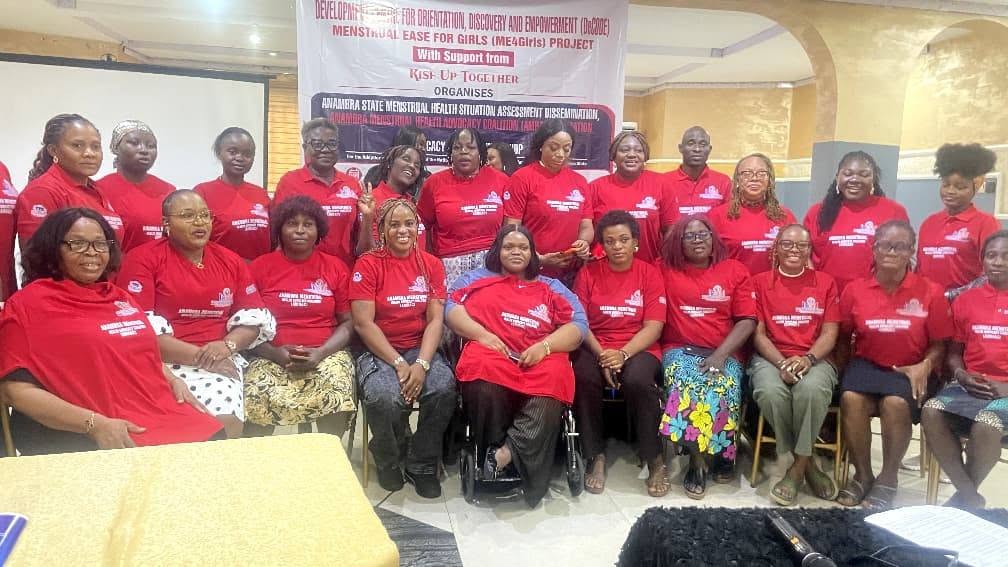
Participants reviewed findings from the ME4Girls Situation Assessment, examined the national menstrual health policy framework and developed strategies for translating the policy into practical interventions across Anambra schools.
A major outcome of the meeting was the agreement to establish the Anambra Menstrual Health Advocacy Coalition, a multi-stakeholder platform that will coordinate policy engagement, advocacy and implementation efforts across the state.
According to the communiqué issued at the end of the workshop, participants stressed that collaboration between government institutions and non-state actors is essential to ensuring that schoolgirls have access to comprehensive menstrual health education, functional and gender-responsive water, sanitation and hygiene (WASH) facilities, and a school environment that supports them during menstruation.
The stakeholders also called on the Anambra State Government to develop and endorse a comprehensive implementation framework specifically for public secondary schools.
The proposed framework, they said, should integrate menstrual health education into school activities, improve access to safe and private sanitation facilities, and establish effective support systems to reduce period-related absenteeism among girls.
Participants further emphasised that policy adoption alone would not be enough.
They called for evidence-based planning, continuous research, monitoring and accountability to ensure that menstrual health interventions are effectively implemented and sustained.
To support the initiative, stakeholders pledged to mobilise technical, financial and institutional resources from government agencies, development partners, non-governmental organisations, communities and the private sector.
Representatives also committed to becoming menstrual health champions within their respective institutions, participating actively in the new coalition and supporting public awareness campaigns aimed at dismantling the stigma surrounding menstruation.
They further pledged to strengthen inter-agency collaboration, share relevant data and implement the objectives contained in the project’s advocacy roadmap.
As immediate next steps, the coalition will finalise the workshop report and communiqué, activate the advocacy roadmap, engage key government decision-makers and continue technical consultations toward developing the public secondary school implementation framework.
Participants commended DeCODE for providing the platform and acknowledged the growing commitment of the Anambra State Government, development partners and civil society organisations to advancing menstrual health and hygiene.
The stakeholders ultimately reaffirmed a shared commitment to ensuring that no girl in Anambra State is denied education, health, dignity or equal participation in society because of menstruation.
Their message was clear: menstruation is not a reason for exclusion. It is a normal biological process, and ensuring that girls can manage it safely and with dignity is essential to keeping them healthy, confident and in school.
#