News
Idemili North Mayor Summons Stakeholders Summit Over Erosion, Flooding Threats

By Mary Obi
The battle against erosion, flooding and environmental degradation in Idemili North Local Government Area of Anambra State has entered a new phase, with the council mayor, Chief Stanley Nkwoka, convening a stakeholders’ summit to mobilise communities and government institutions for urgent action.
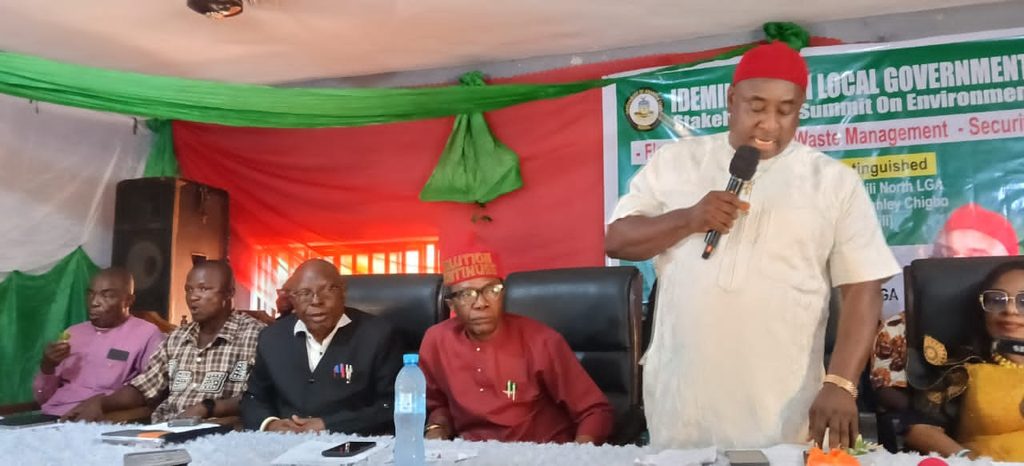
The summit, held in Ogidi, brought together traditional rulers, town union leaders, market and youth leaders, government officials and other stakeholders to develop practical measures for confronting the council’s growing environmental challenges.
Declaring the summit open, Nkwoka said environmental degradation had become one of the most serious threats facing Idemili North and Anambra State, warning that failure to act collectively could worsen the situation.
According to him, although the local government has made significant progress in tackling insecurity with the support of Governor Chukwuma Soludo, environmental concerns now require similar attention.
“Environmental protection is a collective responsibility. We cannot leave it to government alone. Traditional rulers, town unions, market leaders, youths, women and residents all have roles to play,” Nkwoka said.
The mayor described Idemili North as one of the most densely populated local government areas in Anambra State, stressing that the scale of the environmental challenges made grassroots participation indispensable.
He particularly blamed indiscriminate refuse disposal and blocked drainage channels for worsening flooding in several communities, warning residents against dumping waste, sand and other debris in waterways.
Nkwoka expressed confidence that the resolutions reached at the summit would receive the support of the state government, assuring stakeholders that the council would pursue their implementation through sustained community engagement, public enlightenment and collaboration.
The summit was attended by the Anambra State Commissioner for Environment, Dr. Clem Aguiyi; Commissioner for Information and Value Reorientation, Dr. Law Mefor; Executive Director of the Anambra State AIDS Control Agency, Dr. Nkem Okeke; presidents-general, youth leaders, market leaders and other stakeholders.
Speaking at the event, Aguiyi described environmental degradation as “Anambra State’s greatest existential threat,” warning that unchecked erosion, flooding and deforestation could have devastating consequences for the state’s landmass in the coming decades.


He disclosed that the state government would soon begin strict enforcement of a requirement for residential buildings, compounds and business premises to provide catchment pits as part of measures to control stormwater and reduce flooding.
The commissioner commended Nkwoka for convening the summit, describing it as an example of grassroots environmental governance that could be replicated across other local government areas.
Aguiyi said recent flooding incidents in Idemili North and other parts of Anambra had demonstrated the urgency of coordinated action. He identified indiscriminate tree felling, blocked drainage systems and poor waste disposal as major contributors to erosion and flooding.
He urged residents to embrace tree planting and responsible environmental practices, while directing local government areas to establish Town Union Environmental Committees down to the village level.
The committees, he said, would strengthen enforcement of environmental laws and give communities greater ownership of environmental protection initiatives.
In another development, Engineer Ochokwu Uzochukwu of Abatete Community announced that Idemili North Local Government would commence digital mapping of communities on Google Maps from September to improve environmental monitoring, emergency response and security.
According to him, the project, championed by Nkwoka, would begin in Nkpor, Ogidi, Abatete, Ideani and Uke before expanding to all 10 communities in the local government area.
Uzochukwu said the technology-driven initiative would enhance disaster response, improve environmental surveillance and facilitate proper documentation of erosion and flooding incidents.
Also speaking, the State Public Relations Officer of the United Nigeria Chaplaincy, Okoye Chinwe, urged residents to desist from dumping refuse in waterways, particularly during rainfall.
She also advocated compulsory provision of toilet facilities in residential buildings as part of efforts to improve sanitation and protect public health.
For Dr. Nkem Okeke, poor environmental management has direct consequences for public health.
He urged residents to translate the summit’s resolutions into concrete actions, stressing that a cleaner and better-managed environment would contribute significantly to improved health outcomes across the local government area.
At the end of the summit, stakeholders adopted a series of resolutions aimed at strengthening environmental management in Idemili North.
The resolutions included stricter enforcement of environmental laws; compulsory stormwater management systems in buildings; regular desilting of drainage channels; restoration of natural waterways; reintroduction of monthly environmental sanitation; establishment of environmental monitoring and enforcement committees; intensified public enlightenment campaigns; and stronger collaboration among government agencies, traditional institutions and communities.
The summit ended with a renewed commitment by stakeholders to move beyond discussions and take sustained, community-driven action against erosion, flooding, indiscriminate waste disposal and other forms of environmental degradation threatening Idemili North.
#