Opinion
Eke Awka Is Drowning in Refuse—How Many More Lives Must Be Put at Risk Before Authorities Act?

By Polycarp Onwubiko
A public health emergency is unfolding in the heart of Anambra’s capital, and continued inaction by those responsible is becoming impossible to justify.
A city’s cleanliness is more than a matter of aesthetics—it is a reflection of governance, public health, and respect for human dignity. When refuse piles up in markets, streets, and residential areas, it sends a troubling message: the health and welfare of citizens have become secondary concerns.
That is the disturbing reality confronting traders, residents, and visitors at Eke Awka Market, the commercial heartbeat of Anambra State capital. What should be one of the state’s busiest economic centres has gradually become a breeding ground for disease, foul odour, and environmental neglect.
The mountains of refuse lining parts of the market, particularly along Arthur Eze Avenue, are no longer merely an environmental nuisance. They represent a public health emergency demanding urgent intervention.
Public Health Cannot Be an Afterthought
Across the world, governments place healthcare at the centre of development because no economy can thrive when its citizens are constantly exposed to preventable diseases.
While hospitals treat illness, sanitation prevents it. Poor waste management contributes directly to outbreaks of cholera, typhoid, diarrhoea, malaria and other communicable diseases. Decaying waste attracts flies, rats, mosquitoes and other disease vectors, while toxic gases released from decomposing refuse pollute the air breathed daily by traders and shoppers.
In a country already battling overstretched healthcare facilities and rising medical costs, allowing refuse to accumulate in major urban markets is both economically and morally indefensible.
The Local Government’s Constitutional Responsibility
Nigeria’s Constitution assigns environmental sanitation and waste management primarily to local government councils. For this reason, residents naturally expect local authorities to ensure refuse is collected promptly and disposal systems function efficiently.
Unfortunately, in many urban centres—including Awka—the opposite appears to be happening. Following the renewed emphasis on local government responsibility for waste management, many communities have witnessed increasing refuse accumulation instead of improved sanitation.
Whether caused by inadequate funding, poor planning, weak supervision or administrative inefficiency, the outcome remains the same: citizens bear the consequences.
Eke Awka Market: A Symbol of Institutional Failure
Eke Awka Market is one of the busiest commercial centres in Anambra State. Thousands of traders, transport operators and customers pass through the market daily.

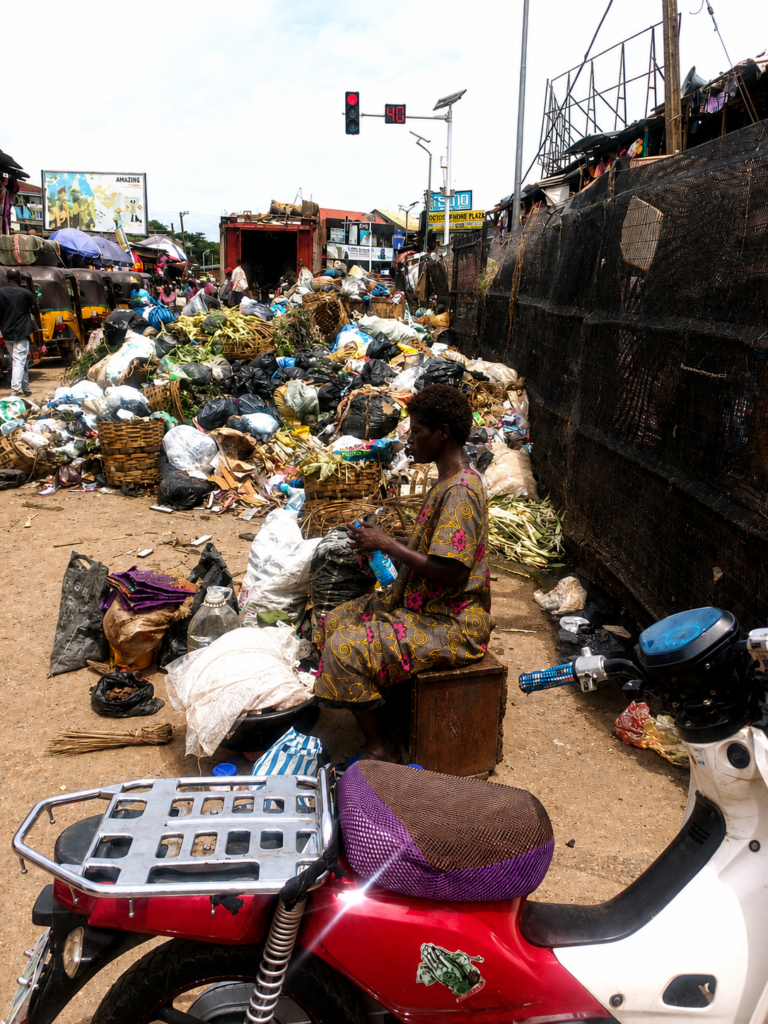
Yet, enormous heaps of decomposing refuse greet visitors at strategic locations. Shop owners conduct business metres away from rotting waste. Food vendors operate in an environment contaminated by flies. Customers cover their noses as they navigate pathways overwhelmed by unbearable stench.
This situation has persisted for years despite repeated complaints from traders and residents. Environmental neglect on this scale should never become normal.
The Human Cost Behind the Refuse
Behind every refuse heap are real people whose health and livelihoods are at risk. Market traders spend long hours breathing polluted air. Children accompany parents to the market. Pregnant women, elderly citizens and individuals with weakened immune systems are routinely exposed to unhealthy environmental conditions.
Many waste collectors themselves work without adequate protective equipment such as gloves, face masks, boots and overalls. Expecting sanitation workers to perform such hazardous duties without proper safety gear exposes them to unnecessary occupational health risks and falls short of acceptable workplace safety standards.
A society that values human life cannot ignore those who perform one of its most essential public services.
Waste Management Requires More Than One Truck
Observations at Eke Awka suggest that refuse evacuation remains grossly inadequate for the volume of waste generated daily. A single refuse collection vehicle cannot effectively service a market of such commercial importance. Waste inevitably accumulates faster than it is removed.
Modern cities invest in specialized compactor trucks, scheduled waste collection, waste segregation, transfer stations and regular environmental monitoring.
Markets generating substantial revenue deserve sanitation infrastructure that matches their economic importance. Without adequate investment, refuse will continue to overwhelm available capacity.
Accountability Must Accompany Revenue
Eke Awka Market generates significant revenue through taxes, levies and various commercial activities. Citizens therefore have every right to expect visible improvements in sanitation and environmental management. Public funds should translate into public services. Waste collection vehicles should be sufficient. Cleaning personnel should be properly equipped.Collection schedules should be consistent.
Environmental health officers should actively enforce sanitation regulations. Transparency in the management of market-generated revenue would also help build public confidence that resources are being directed toward improving essential services.
Enforcement Is Equally Important
Government alone cannot solve the problem. Every trader has a responsibility to dispose of waste properly. Markets should provide strategically located waste bins and collection points, while environmental officers must strictly enforce sanitation regulations.
Anyone who deliberately dumps refuse outside designated collection areas should face appropriate penalties. Clean environments require both effective government action and responsible public behaviour.
Time for Immediate Action
The solution is neither mysterious nor impossible. Awka South Local Government should: Deploy multiple refuse collection vehicles to Eke Awka Market. Establish designated waste collection points throughout the market. Ensure daily evacuation of refuse without exception.
Provide sanitation workers with adequate protective equipment. Intensify routine cleaning and disinfect contaminated areas. Introduce waste segregation and recycling initiatives. Enforce sanitation laws through regular inspections and penalties for offenders.
The Anambra State Government should also strengthen oversight, monitor environmental sanitation across all local government areas and ensure that waste management meets acceptable public health standards.
A Market Deserves Better
Eke Awka is more than a marketplace. It is a symbol of commerce, enterprise and the economic energy of Anambra State. Allowing refuse to define its image diminishes not only the market but the reputation of Awka itself.
No trader should have to earn a living beside mountains of waste. No customer should risk illness simply by visiting a market. No capital city aspiring to excellence should tolerate environmental conditions that threaten public health.
Clean markets are not a luxury. They are a basic responsibility of government and a fundamental right of every citizen. The time for excuses has passed. The time for decisive action is now.
Onwubiko, A Veteran Journalist and Public Affairs Commentator Writes from Awka, Anambra State