News
World Anti-Trafficking Day: Expose Human Traffickers Before They Destroy More Lives, Anambra Residents Told

By Praise Chinecherem
Residents of Anambra State have been urged to expose human traffickers and reject deceptive promises of greener pastures that continue to claim lives and destroy families.
The call was made during a statewide sensitisation campaign to commemorate the 2026 World Day Against Trafficking in Persons, organised by the Anambra State Government in collaboration with the Civil Society Network on Migration and Development (CSONetMaDe), security agencies and other stakeholders.
Speaking at the event in Awka, the Commissioner for Women and Social Welfare, Mrs. Esther Onyekesi, reaffirmed the commitment of the Governor Chukwuma Soludo administration to combating human trafficking and related crimes.
“Anambra remains welcoming to residents and visitors, but this administration has zero tolerance for human trafficking and every form of exploitation. We urge citizens to report traffickers before more innocent lives are destroyed,” she said.
Onyekesi commended CSONetMaDe and the Network Against Child Trafficking, Abuse and Labour (NACTAL) for sustaining advocacy against human trafficking and irregular migration, describing their partnership with the government as crucial in tackling the growing menace.
She assured that the Ministry of Women and Social Welfare would continue collaborating with organisations genuinely committed to protecting vulnerable persons and eliminating trafficking.
The Anambra State Coordinator of CSONetMaDe and NACTAL, Eucharia Onyemaobi, stressed that families remain the first line of defence against traffickers, urging parents and guardians to educate themselves and their children about the dangers of trafficking.

“Human trafficking thrives on deceit, exploitation, organ harvesting and other forms of abuse. Families must be informed so they can identify warning signs, make informed decisions and protect their loved ones,” she said.
She warned young people against allowing desperation or the glamorous lifestyles portrayed on social media to influence life-changing decisions.
“Many traffickers prey on people’s desire for quick success. Not everything you see online reflects reality. Question every offer that appears too good to be true,” Onyemaobi cautioned.
According to her, the public awareness campaign, particularly at motor parks across Awka, generated positive responses, with participants asking critical questions that would strengthen future advocacy and policy engagement.
She also commended Governor Chukwuma Soludo for signing the Anambra State Human Trafficking Law and praised the Governor’s wife, Dr. Nonye Soludo, for supporting survivors, including the recent rescue and rehabilitation of a trafficking victim.
Onyemaobi, however, warned that internal human trafficking is becoming an emerging threat that requires urgent and sustained intervention.
Chairperson of the International Federation of Women Lawyers (FIDA), Anambra State Branch, Barr. Amara Muojeke, said traffickers often exploit economic hardship by luring victims with fake employment opportunities and promises of a better future.
She urged residents to report suspected trafficking cases to FIDA, the Ministry of Women and Social Welfare, the Nigeria Immigration Service (NIS), the Nigeria Security and Civil Defence Corps (NSCDC) and other relevant authorities.
Referring to the recent rescue of trafficked children in Aguleri, Anambra East Local Government Area, Muojeke said public vigilance made the operation possible.
“Those children were rescued because someone refused to remain silent. Every victim is someone’s child, sister or brother. If you suspect trafficking, report it immediately. Your action could save a life,” she said.
While acknowledging that economic hardship contributes to trafficking, she insisted that poverty should never justify falling victim to criminal networks.
She highlighted the Anambra Government’s ‘One Youth, Two Skills’ empowerment initiative as one of the programmes designed to equip young people with legitimate income-generating skills.
“There are genuine opportunities for young people to learn skills and build sustainable livelihoods. Never gamble your future for the illusion of quick wealth,” she added.
Also speaking, the Deputy Commandant of the Nigeria Security and Civil Defence Corps (NSCDC) and Head of the Anti-Human Trafficking Unit, Edith Ebere Nwufoh, explained that traffickers operate using what she described as the three Rs — Reason, Recruitment and Routes.
According to her, traffickers are driven primarily by financial gain, recruit victims through deception and carefully map out routes for moving them across states and international borders.
She appealed to commercial drivers and transport operators to partner with security agencies by reporting suspicious movements involving children and young persons.
Nwufoh also highlighted the three Ps of anti-trafficking efforts — Prevention, Prosecution and Partnership, stressing that ending human trafficking requires collaboration among parents, teachers, religious leaders, transport operators, security agencies and civil society organisations.
Participants at the awareness campaign called on Nigerians to remain vigilant, reject suspicious offers and promptly report trafficking-related activities, insisting that sustained public awareness remains one of the strongest weapons against human trafficking.
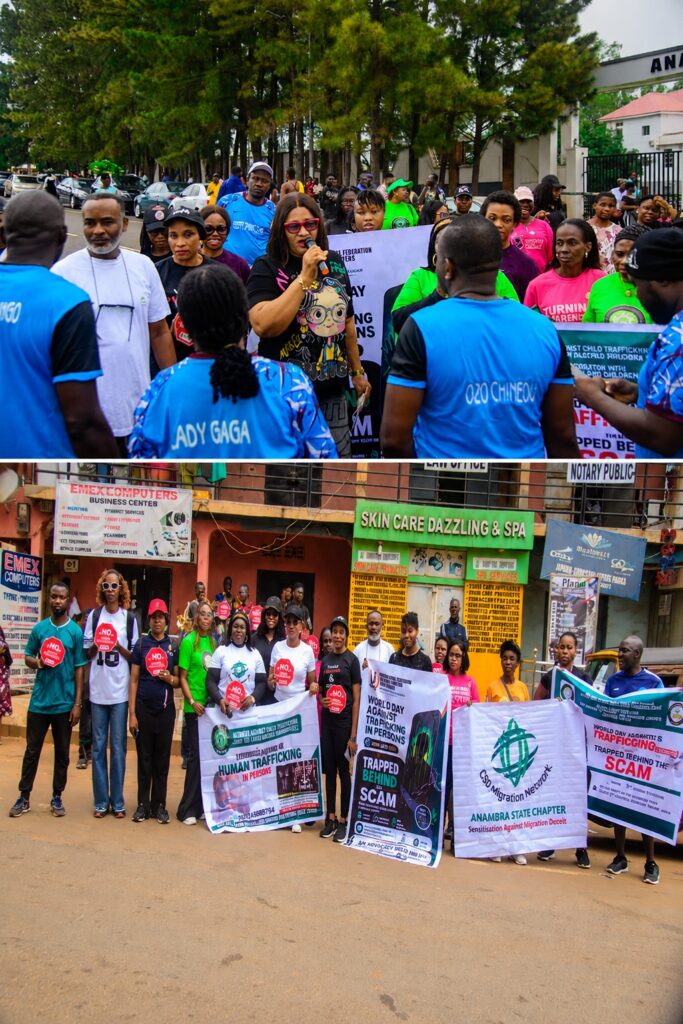
Held under the theme, “Trapped Behind the Scam,” the campaign featured officials from FIDA, NSCDC, NIS, NACTAL, CSONetMaDe and the Anambra State Ministry of Women and Social Welfare.
Participants marched from the Anambra State House of Assembly Complex in Awka to major motor parks and other public places, educating residents on the dangers of human trafficking, the deceptive tactics used by traffickers and the importance of speaking out to save lives.