News
Human Rights Lawyer Writes Tinubu, Seeks Comprehensive Review of Cases Involving South-East Detainees in Prolonged Custody

By Chukwudi Ebele
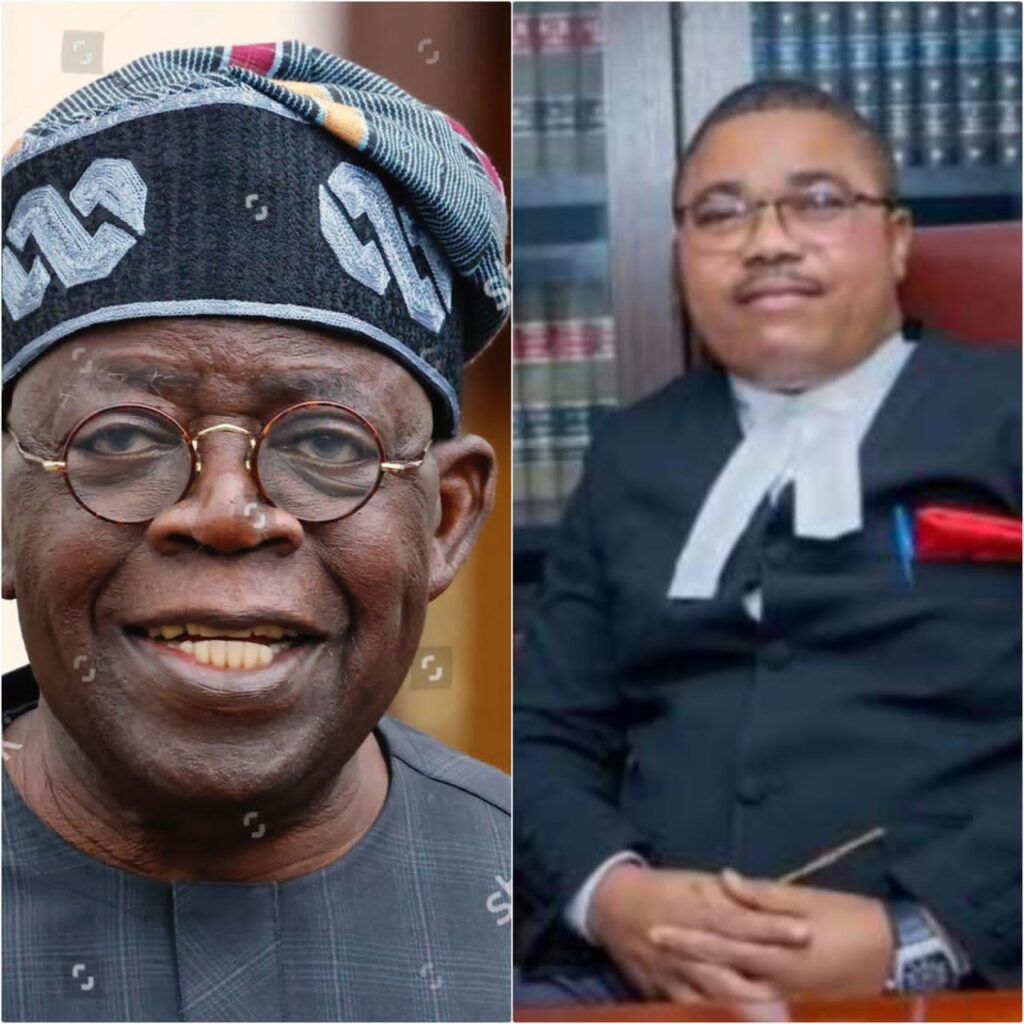
Defense Counsel to the Indigenous people of Biafra IPOB and Human Rights Lawyer, Sir Ifeanyichukwu Ejiofor Esq has written an open letter to President Bola Ahmed Tinubu Pleading with him to Direct the Attorney General of the Federation and Minister of Justice to undertake a comprehensive legal review of the cases involving detainees from the South-East who have remained in prolonged custody, languishing in Nigeria prisons.
The letter urging the President to resolve the cases with justice, compassion, constitutional fidelity and uncommon statesmanship which was made available to newsmen, reads thus:
“AN OPEN LETTER TO HIS EXCELLENCY, PRESIDENT BOLA AHMED TINUBU, GCFR
From Conflict to Concord: A Statesman’s Opportunity to Complete Nigeria’s Unfinished Promise of Reconciliation in the South-East
His Excellency, President Bola Ahmed Tinubu, GCFR President and Commander-in-Chief of the Armed Forces Federal Republic of Nigeria, Aso Rock Villa Abuja, Nigeria.
Your Excellency,
INTRODUCTION
HISTORY HAS ENTRUSTED YOUR ADMINISTRATION WITH A RESPONSIBILITY THAT TRANSCENDS POLITICS: TO CONSOLIDATE THE HARD-EARNED PEACE IN THE SOUTH-EAST BY ENSURING THAT JUSTICE, RECONCILIATION, AND THE RULE OF LAW BECOME THE ENDURING PILLARS OF NATIONAL UNITY.
I write this open letter with profound respect for the high office you occupy and with an abiding faith in the capacity of courageous leadership to alter the course of history.
This intervention is neither partisan nor adversarial. Rather, it is an earnest appeal founded upon history, conscience, constitutionalism, and an unwavering desire for enduring peace in our beloved country and homeland.
I have deliberately chosen this subject because history must never be divorced from contemporary realities. No meaningful solution can emerge where the origins of a crisis are ignored or deliberately forgotten. Nations progress only when they possess the courage to confront uncomfortable truths with honesty and statesmanship.
THE HISTORICAL CONTEXT
Your Excellency, the insecurity that had hitherto engulfed the South-East did not arise in a vacuum. It was the product of a complex convergence of political, social, economic and security factors that progressively deepened mistrust between the people and the State.
Many citizens of the South-East perceived themselves as politically marginalised, economically neglected, and increasingly vulnerable to violent attacks upon their communities by jihadist herdsmen, which at the time appeared largely unchecked. These perceptions, whether universally shared or not, created fertile ground for despair, alienation and radicalisation. In such an atmosphere, misinformation, inflammatory rhetoric and unrealistic promises found willing audiences among vulnerable young people.
It is pertinent to observe, Your Excellency, that the proscription of the Indigenous People of Biafra (IPOB) by your predecessor, an action widely perceived by many as politically motivated, unquestionably contributed to the volatile and precarious security landscape which your administration has, to a considerable extent, succeeded in containing. Equally significant is the fact that, over the years, a substantial number of people of Igbo extraction came to regard membership of IPOB not as an act of criminality or subversion, but as an expression of identity, cultural consciousness and collective aspiration.
The deterioration of security assumed even more alarming proportions following the extraordinary rendition of Nnamdi Kanu and the subsequent developments within the broader Biafra agitation. The emergence of competing voices, particularly that of Simon Ekpa, claiming authority over the movement, further complicated an already volatile situation and coincided with one of the darkest periods experienced in the South-East since the end of the Nigerian Civil War.
During those difficult years, countless innocent citizens lived in fear. Communities became theatres of violence. Businesses collapsed. Families were displaced. Economic activities suffered devastating setbacks. Public confidence in governmental institutions steadily eroded.
Many political leaders relocated from the South-East, distancing themselves from the harsh realities confronting their constituents, while those of us who consistently condemned violence from every quarter often found ourselves misunderstood, vilified and, in some instances, declared persona non grata within our own communities. Nevertheless, our commitment to peace and the rule of law remained unwavering because silence in the face of violence has never been an option.
Numerous allegations also emerged during that period concerning arrests, prolonged detentions, disappearances and other security operations affecting many young men and women from the South-East. These allegations continue to evoke profound concern among families and human rights advocates and deserve careful legal and institutional attention wherever they remain unresolved.
ACKNOWLEDGING THE PROGRESS OF YOUR ADMINISTRATION
Your Excellency, it is therefore only fair to acknowledge that your administration has demonstrably adopted a markedly different approach in the management of security and the administration of justice in relation to the South-East.
The changes introduced within the leadership of the Department of State Services, together with the constructive engagement of the Office of the Honourable Attorney-General of the Federation, have contributed to measurable improvements in the security atmosphere across much of the South-East. Those efforts deserve commendation.
Equally noteworthy have been developments outside Nigeria that have reduced the influence of the individual whose public broadcasts and activities were widely believed to have aggravated tensions within the region and desecrated Ala-Igbo.
These developments demonstrate an important truth: sustainable peace is rarely achieved through force alone. It is secured through intelligence, dialogue, justice, institutional restraint and public confidence.
Your Excellency, this historical context is indispensable because it forms the foundation of the humble appeal I now place before you.
THE REMAINING CHALLENGE
While some of these detainees have reportedly regained their freedom, many others remain in custody after years of incarceration. Reports concerning the prolonged detention of numerous young people of Igbo extraction continue to generate deep concern across the South-East.
Recent prosecutions involving persons accused of terrorism have equally raised important questions. It has been observed that some individuals from the South-East who had been detained for several years were prosecuted alongside Boko Haram suspects accused of devastating terrorist activities. These developments have understandably generated anxiety, particularly where the factual circumstances surrounding individual cases appear materially different.
Consequent upon their appearance before the Federal High Court, Abuja, I personally undertook an independent examination of both the charges and the accompanying Proof of Evidence. To my utmost consternation, I discovered that the charges preferred against the majority of these young Igbo men, who had already languished in detention for almost a decade, were predicated principally upon allegations of IPOB membership and payment of dues.
Even more alarming was the revelation that many of them were allegedly induced or pressured into entering guilty pleas, following which they were summarily convicted and sentenced to terms of imprisonment ranging from twenty to forty years. These convictions, if accurately represented, raise profound constitutional concerns regarding the guarantees of due process, including the right to a full, fair and public hearing before a court of competent jurisdiction.
Every Nigerian, irrespective of ethnicity, political persuasion or ideological inclination, remains entitled to the full protection of Sections 35 and 36 of the Constitution of the Federal Republic of Nigeria, which guarantee personal liberty and the right to a fair hearing.
Those who have committed recognisable criminal offences should unquestionably face prosecution before competent courts of law and, if convicted after a fair trial, bear the full consequences prescribed by law.
Conversely, those whose continued incarceration rests primarily upon disputed assumptions, insufficient evidence or mere association deserve an impartial review consistent with the Constitution, the principles of natural justice and Nigeria’s international human rights obligations.
A MOMENT FOR NATIONAL RECONCILIATION
Your Excellency, many of these young men appear less as hardened criminals than as products of frustration, misinformation and manipulation.
The question before history, therefore, is not merely what these young people did. The more profound question is why so many of them became susceptible to such narratives in the first place.
Was it despair?
Was it the perception of exclusion?
Was it the lingering feeling that the promises made at the conclusion of the Nigerian Civil War had never been fully realised?
These questions deserve thoughtful national reflection rather than emotional dismissal.
Permit me, Your Excellency, to respectfully revisit one of the most solemn understandings associated with the end of the Civil War – the commitment to the principles commonly remembered as the Three “Rs”:
- Reconciliation
- Rehabilitation
- Reconstruction
These principles represented far more than political slogans. They constituted a solemn national undertaking that the wounds of war would never be permitted to harden into permanent divisions within the Nigerian Federation. They embodied Nigeria’s moral covenant that never again would any section of our nation feel permanently estranged from the Nigerian project.
More than five decades later, many citizens of the South-East continue to question whether these historic commitments have been fully realised in both spirit and practice.
History now presents your administration with an uncommon opportunity to transform those enduring aspirations into tangible realities.
A RESPECTFUL APPEAL
Your Excellency, I respectfully urge you to consider directing the Honourable Attorney-General of the Federation and Minister of Justice to undertake a comprehensive legal review of the cases involving detainees from the South-East who have remained in prolonged custody under circumstances that continue to attract serious legal and humanitarian concerns.
Such an initiative would not constitute an act of political concession.
It would represent a profound affirmation of constitutional governance.
It would reinforce public confidence in the administration of justice.
It would deepen the peace that your administration has helped to restore across much of the South-East.
Most importantly, it would demonstrate that the Federal Republic of Nigeria possesses both the strength to uphold the law and the wisdom to temper justice with fairness.
CONCLUSION
Your Excellency, history reserves its highest honours not for leaders who merely inherit difficult circumstances, but for those who summon the courage to resolve them with justice, compassion, constitutional fidelity and uncommon statesmanship.
The peace presently taking root across the South-East provides a rare opportunity that should neither be underestimated nor squandered.
If this moment is consolidated through justice, fairness and reconciliation, posterity may well remember your Presidency as the administration that finally closed one of the most painful chapters in Nigeria’s post-war history.
Such a legacy would transcend politics and become an enduring testament to national healing through courageous leadership.
That would be a legacy worthy of enduring national remembrance.
May this administration seize this defining moment to demonstrate that justice remains the surest foundation of national security, and that reconciliation, when anchored upon the rule of law, is the greatest instrument of enduring peace.
I thank Your Excellency for your attention to this humble appeal and remain hopeful that wisdom, constitutional fidelity and national unity will continue to guide your administration.
Please accept, Your Excellency, the assurances of my highest consideration.
Yours faithfully,
Sir Ifeanyi Ejiofor, Esq., KSC
Dunu-Ezeugosinachi”.