Opinion
Fifteen Years Too Long: Why Anambra Must End the Injustice of Unharmonised Pensions

By Polycarp Onwubiko
A society is ultimately judged not by the grandeur of its roads, bridges and government buildings, but by how it treats those who spent the best years of their lives serving it.
In Anambra State, thousands of pensioners who retired before May 2011 have waited for what they insist is their constitutional entitlement—pension harmonisation. For them, the passage of time has not brought relief but deepening hardship. Fifteen years after the last major review, many continue to survive on pensions they argue no longer reflect today’s economic realities, even as the cost of living continues to soar.
The question is no longer whether pension harmonisation should happen. The more pressing question is: why has it taken so long?
Nigeria’s Constitution provides that pensions should be reviewed periodically and whenever a new minimum wage is approved. The objective is straightforward—to ensure that retired public servants can maintain a reasonable standard of living despite inflation and changing economic conditions.
For pensioners, harmonisation is not a political favour. It is a legal obligation and, more importantly, a moral responsibility.
Over the last two decades, three successive administrations in Anambra—those of Peter Obi, Willie Obiano and the incumbent, Professor Chukwuma Soludo—have each earned recognition for different developmental achievements. Yet, from the perspective of affected pensioners, all three administrations share one unresolved legacy: the continued delay in implementing pension harmonisation for retirees who left the civil service before May 2011.
This is not to dismiss the achievements recorded in infrastructure, education, healthcare, security or economic reforms. Governor Soludo, in particular, has received widespread commendation for his ambitious urban renewal projects and developmental agenda.
However, good governance should not force citizens to choose between infrastructure and human welfare.
Development is measured not only in kilometres of roads constructed or flyovers commissioned, but also in the dignity accorded to citizens—especially senior citizens who once formed the backbone of the public service.
Many of today’s pensioners devoted three or four decades of their productive years to building the institutions that successive governments now administer. They educated children, managed public finances, maintained hospitals, staffed schools and kept government machinery running. Retirement should reward that sacrifice, not condemn them to poverty.
For many retirees, the challenge is no longer paying school fees or building houses. It is purchasing prescribed medication, feeding their families and meeting basic healthcare needs.
According to pension advocates, several committees have been constituted over the years to examine pension harmonisation, while verification exercises and audits have repeatedly been conducted. Yet implementation has remained elusive.
The result, they argue, has been years of uncertainty and disappointment.
Every delay carries human consequences.
Some pensioners have reportedly died while waiting for harmonisation. Others continue to struggle with declining health, rising medical bills and shrinking purchasing power.
No committee report can compensate for years lost to avoidable hardship.
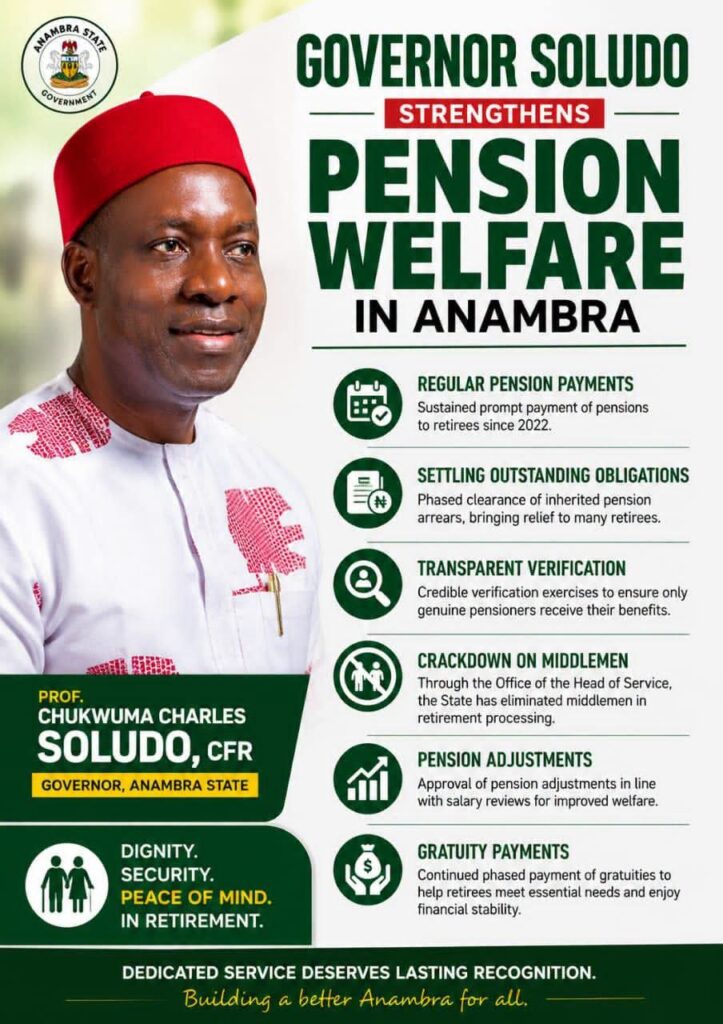
Supporters of the current administration may point to the government’s consistent payment of monthly pensions and the additional ₦10,000 approved for pensioners as evidence of commitment.
While these measures deserve acknowledgement, affected retirees argue that they do not address the central issue.
Their demand is not merely for regular payment but for payment based on harmonised pension rates consistent with constitutional provisions and prevailing wage adjustments.
This distinction is important.
Receiving an outdated pension promptly is not the same as receiving the correct pension.
The argument frequently advanced that limited resources prevent implementation also deserves closer scrutiny.
Since the removal of fuel subsidy, federal allocations to states have increased significantly. At the same time, Anambra continues to generate substantial internally generated revenue while executing numerous capital projects.


If resources exist for large-scale infrastructure, pensioners reasonably ask whether government can also prioritise those whose welfare depends entirely on monthly pension payments.
This should not be framed as a contest between infrastructure and pension obligations.
Government must pursue both.
Roads, airports and commercial cities are important investments. But infrastructure achieves its highest purpose only when the people it is meant to serve are alive and healthy enough to benefit from it.
A state that celebrates physical development while neglecting its elderly public servants risks undermining the moral foundation of governance.
Governor Soludo has repeatedly demonstrated willingness to confront difficult reforms.
The issue of pension harmonisation presents another opportunity—not merely to fulfil a legal obligation but to leave a lasting legacy of compassion and justice.
Ordering the immediate implementation of pension harmonisation, alongside a transparent framework for settling outstanding arrears where legally due, would restore confidence among pensioners and reaffirm government as a protector—not merely an administrator—of public welfare.
History rarely remembers governments only for the projects they completed.
It remembers how they treated the vulnerable.
For Anambra, resolving the long-standing pension harmonisation dispute would not diminish the state’s developmental achievements. Rather, it would complete them.

As the Igbo proverb reminds us, “Ezi ọchịchị na-amalite n’ịhụ mmadụ n’anya”—good leadership begins with valuing human life.
After fifteen years of waiting, Anambra’s pensioners deserve more than promises. They deserve justice.
Onwubiko wrote from Awka, Anambra State