News
Hope for Victims of Abuse as RULAAC Launches South-East Human Rights Bureau, Targets Impunity, Justice

By Praise Chinecherem
Victims of human rights abuses across Nigeria’s South-East may soon have a stronger platform to seek justice following the launch of the South-East Human Rights Bureau, a landmark initiative designed to document abuses, support survivors, strengthen accountability and promote the rule of law across the region.
The Bureau, unveiled in Enugu by the Rule of Law and Accountability Advocacy Centre (RULAAC) with support from the Ford Foundation, is expected to serve as a regional hub for documenting human rights violations, coordinating legal interventions and building partnerships among government institutions, security agencies, civil society organisations and local communities.
The launch also featured the unveiling of a cutting-edge Open-Source Reporting Platform and the training of human rights defenders drawn from the five South-East states to improve the documentation, verification and reporting of human rights violations.

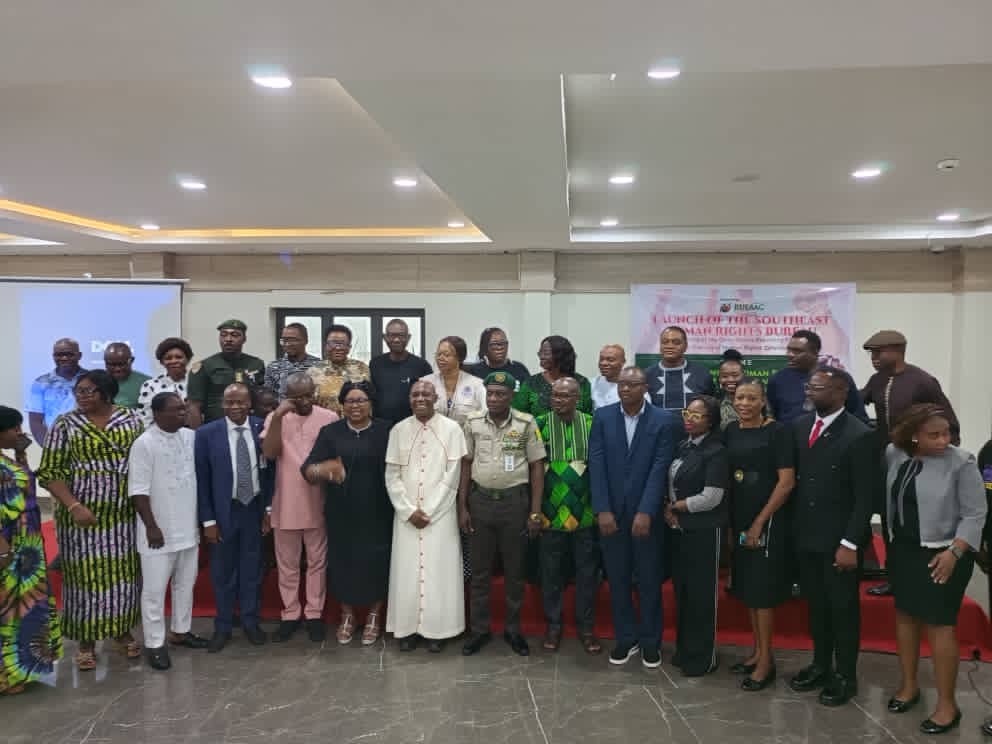
Speaking at the two-day event themed “Strengthening Human Rights, Accountability, Peace and Security in Southeast Nigeria,” stakeholders unanimously stressed that sustainable peace and effective security can only thrive where citizens’ rights are respected and protected.
Bureau to Drive Justice, Accountability
Executive Director of RULAAC, Mr. Okechukwu Nwanguma, described the inauguration of the Bureau as the realization of a vision first conceived during the South-East Stakeholders Summit on Peace, Security and Human Rights held about 17 months ago.
According to him, the Bureau is not intended to replace existing institutions but to complement their work through credible documentation, strategic advocacy, dialogue and legal interventions aimed at ending impunity.
“The Southeast Human Rights Bureau will serve as a trusted regional mechanism for documenting violations, supporting victims, strengthening accountability and promoting evidence-based advocacy,” Nwanguma said.
He explained that the newly launched Open-Source Reporting Platform would provide a secure digital system for documenting abuses, preserving evidence, verifying reports and generating reliable data for advocacy and policy reforms.
Beyond documentation, he disclosed that the Bureau would actively support strategic litigation against perpetrators of serious abuses.
“Where necessary, the Bureau will support strategic legal interventions to address patterns of serious human rights violations and institutional impunity.”
Nwanguma revealed that RULAAC is already consulting with lawyers, human rights defenders and partner organisations on a proposed class action lawsuit on behalf of victims of the notorious Tiger Base, an initiative aimed at securing justice for survivors while pushing for institutional reforms.
“Credible documentation must lead to meaningful accountability. Advocacy becomes more effective when reinforced by strategic legal action.”
Respect for Human Rights Is Key to Security
Chairman of the occasion, Very Rev. Monsignor Prof. Obiora Ike, Professor of Ethics and Intercultural Studies at Godfrey Okoye University, lamented what he described as the growing erosion of the rule of law in Nigeria.
He linked increasing insecurity and criminality to weak enforcement of justice and urged the newly trained human rights defenders to approach their responsibilities with dedication.
“If the rule of law is allowed to weaken, crime flourishes. This Bureau represents an opportunity to restore public confidence in justice and governance.”
Ford Foundation Backs Initiative
Delivering a goodwill message on behalf of the Ford Foundation, Oumar N’Diaye congratulated stakeholders for bringing the initiative to life.
He described the rule of law as the cornerstone of peace, democratic governance and sustainable development.
“We believe this Bureau will strengthen collaboration, deepen justice and promote lasting peace throughout the South-East. The Ford Foundation remains committed to supporting initiatives that protect human dignity.”
NHRC Calls for Professionalism and Evidence-Based Advocacy
The Executive Secretary of the National Human Rights Commission (NHRC), Dr. Tony Ojukwu, represented by the Director of Civil and Political Rights, Halilu Adamu, described the Bureau as an important platform for collaboration among public institutions, civil society organisations and development partners.
He urged members of the Bureau to remain independent, objective and professional.
“Human rights advocacy is most effective when it is evidence-based, impartial and rooted in constitutional and international human rights standards.”
While commending the Open-Source Reporting Platform, Adamu stressed that every allegation of abuse must undergo thorough verification, with due respect for the rights of victims as well as fair hearing for those accused.
He reaffirmed the NHRC’s commitment to supporting initiatives that strengthen Nigeria’s human rights culture.
Correctional Service Seeks Stronger Partnership
Representing the Comptroller-General of the Nigerian Correctional Service, Sylvester Ndidi Nwakauche, the Controller of Corrections, Enugu State Command, CC Valins Obizue, described the Bureau as another milestone in protecting human dignity and promoting accountability.
He highlighted ongoing reforms under the Nigerian Correctional Service Act, 2019, including expanded rehabilitation programmes, vocational training and non-custodial sentencing.
However, he acknowledged that prison congestion remains a significant challenge.
“Addressing custodial congestion requires stronger collaboration among law enforcement agencies, the judiciary, correctional authorities, policymakers and civil society.”
He pledged the Service’s willingness to partner with the Bureau in promoting the rights and rehabilitation of inmates.
Prof. Joy Ezeilo Warns of Growing Human Rights Crisis
Delivering the keynote address, former United Nations Special Rapporteur on Trafficking in Persons, Prof. Joy Ngozi Ezeilo (SAN), described the Bureau as a timely intervention amid worsening human rights challenges across the South-East.
She observed that many communities now find themselves trapped between violent non-state actors and excessive use of force by security agencies.
Prof. Ezeilo also raised concern over what she described as the “modern slavery” affecting young girls trafficked under the guise of domestic employment before being subjected to exploitation and abuse.
“Human rights are not obstacles to security; they are the foundation upon which lasting peace is built.”
She noted that regional institutions like the Human Rights Bureau would bridge the gap between communities and national institutions while expanding access to justice and strengthening evidence-based reforms.
Bureau Will Restore Public Confidence
Unveiling the Bureau’s operations, Director of the Abuja School of Social and Political Thought, Dr. Sam Amadi, expressed optimism that the initiative would rebuild public trust in governance.
“When citizens begin to see credible interventions that address long-standing demands for justice, confidence in public institutions will naturally improve.”
Amnesty International Pledges Support
Researcher with Amnesty International Nigeria, Maurice Chukwu, reaffirmed the organisation’s commitment to partnering with RULAAC in strengthening accountability and human rights protection in the South-East.
He said Amnesty has spent years documenting abuses in the region while consistently demanding independent investigations and justice for victims.
“Our message has remained consistent: every allegation must be independently investigated, victims deserve justice and impunity must end.”
He added that Amnesty International would continue supporting credible documentation, protecting human rights defenders and promoting reforms capable of delivering lasting peace.
“The Southeast Human Rights Bureau has the potential to become a trusted platform for truth, accountability and justice.”
As the Bureau begins operations, stakeholders expressed optimism that its combination of technology-driven reporting, strategic advocacy, legal action and multi-sector collaboration would offer renewed hope to victims of abuse while strengthening peace, accountability and respect for human rights across Nigeria’s South-East.